
 français
 English
 Deutsch
 русский
 español
 português
 العربية
 日本語
日本語 한국의
한국의 Tiếng việt

appelez nous maintenant
TEL : + 86-4000988557;
Skype ID: gfreex@hotmail.com;
WeChat: STEP_ADTECH;
QQ ID: 8936906.

Le marché chinois offre de vastes perspectives. À l'avenir, il disposera d'un important potentiel dans les secteurs de l'électronique, de l'industrie légère, de l'hôtellerie, des services et autres, et de nombreux cas d'application restent à développer. Par conséquent, on peut prévoir que dans les cinq prochaines années, la concurrence sur le marché des robots collaboratifs s'intensifiera. Certaines entreprises s'efforceront de baisser leurs prix pour se démarquer de la concurrence. D'autres, en revanche, continueront d'investir dans la recherche et le développement de leurs technologies existantes et de conquérir des clients grâce à des technologies innovantes, une qualité supérieure et des prix élevés. Du point de vue de l'analyse des stratégies d'entreprise, nous espérons que la plupart des entreprises chinoises adopteront cette dernière approche. Il est indéniable que, pour survivre, les entreprises recherchent des profits immédiats et pratiquent des prix bas. Cependant, du point de vue des stratégies de développement technologique nationales et d'entreprise, l'accent mis sur la recherche et le développement technologiques ainsi que sur la formation des talents est essentiel pour que les produits des entreprises chinoises puissent remplacer les produits importés. Nous espérons vous avoir présenté un aperçu du marché international des robots collaboratifs à travers notre analyse, afin de sensibiliser un plus large public à ces robots et d'attirer l'attention sur ce marché.
The sudden new crown epidemic in 2020 has caused immeasurable losses to the land of China and the world. By the time the report was submitted, we had not yet obtained detailed statistics and analysis of the impact on the world. Therefore, the variables affected by the epidemic are not included in the forecast data of the report. Please understand.
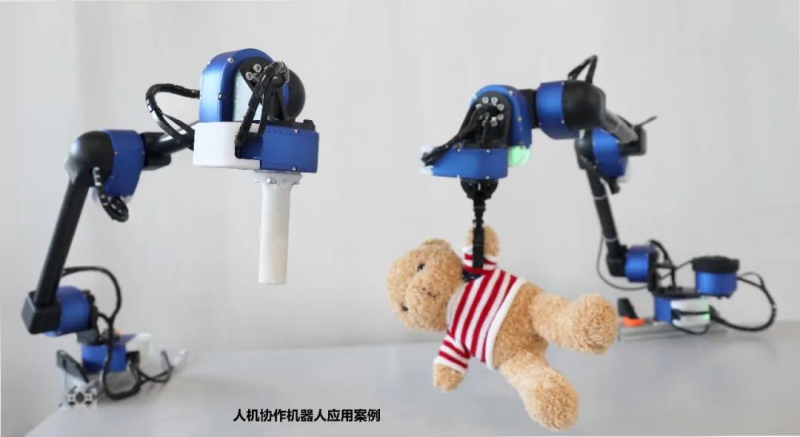
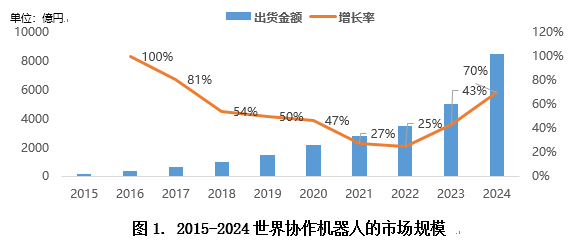
Market Scale Forecast of the World Collaborative Robot Industry
According to data from Japan’s Yano Economic Research Institute, the world collaborative robot market is expected to reach 850 billion yen in 2024, which is approximately 54.6 billion yuan in scale. Collaborative robots will be widely used in new industrial fields such as food, cosmetics, and pharmaceuticals, and service industries such as catering and hotels.
Development Trends and Trends of Cobots in the World
Through the survey of 14 major
collaborative robot
companies in the world and the comparison of product information, we can judge the development direction of collaborative robots from the following aspects. (Refer to the content of the fifth issue)
1. From the perspective of price, the price of a collaborative robot is about 1 million yen, or about 70,000 yuan, and the price of a single-function product or a designated function or miniaturized product is about 15,000 yuan. Low price is the market trend of collaborative robots.
2 From the aspect of operating and setting functions, collaborative robot manufacturers have developed convenient functional software for customers, and some companies have introduced intelligent terminal control systems and APPs. In the future, the use of smart terminals is the direction of development of manipulating collaborative robots.
3. From the perspective of operator education and training, because the operation and movement of
large-scale robot arms
are dangerous, it is necessary to implement special education and training on safety and operation for personnel working with industrial robots. The
robotic arm
of the collaborative robot is easy to install and does not require special training in the law. Therefore, in the limited space of the company, you can learn by yourself by referring to product explanations, reference materials sold in the market, and various information on the Internet. Facilitate the cultivation of talents and the secondary development of product applications.
The using robot companies-end customer demand characteristics
1. In order to ensure product quality, more companies need to purchase collaborative robots. Because of a single simple process, maintaining concentration for a long time, even skilled employees is a great burden. Fatigue and changes in physical condition will lead to a decline in the quality of work. If a robot arm that can work in a narrower working space, work longer or repeat simple actions multiple times, it can free people's hands and ensure the quality of production. In the future, more simple and repetitive tasks in service industries such as industry, catering, and hotels will be replaced by collaborative robots. This will be a key link for companies to ensure product quality and provide efficient services.
2. The company aims to improve productivity. Compared with humans, collaborative robots can increase the working time and run multiple machines in parallel, can maintain the set speed for work, complete the expected work plan, and greatly improve production efficiency. Labor-intensive, standard product production companies will use collaborative robots in large numbers.
3. The enterprise needs to realize business recombination. In the past, industrial robots set the scope and content of the work, and then worked according to the specified program. If you need to change the work content, the process of moving the device is very cumbersome and complicated. Nowadays, companies have increasingly higher requirements for production activities, and being able to flexibly change the scope of work and business content is the actual demand of many companies. Through simple settings, the ability to cope with existing jobs and recombination of business is the future development direction of collaborative robots.
collaborative robot, cobot.
TEL : + 86-4000988557;
Skype ID: gfreex@hotmail.com;
WeChat: STEP_ADTECH;
QQ ID: 8936906.


















s'il vous plaît lisez la suite, restez informé, abonnez-vous, et nous vous invitons à nous dire quoi vous pensez.
 IPv6 réseau pris en charge 粤ICP备2021036697号
 Un service en ligne
 4000988557
 sales1@troysupply.comsales2@troysupply.com
 Richard Liu
 TROY
TROY 8936906
 Troysupply_com